
Applicable to Game Version v1.2.33 and above.
Full tutorial playlist here.
1. Introduction to VTKD
What is VTKD?
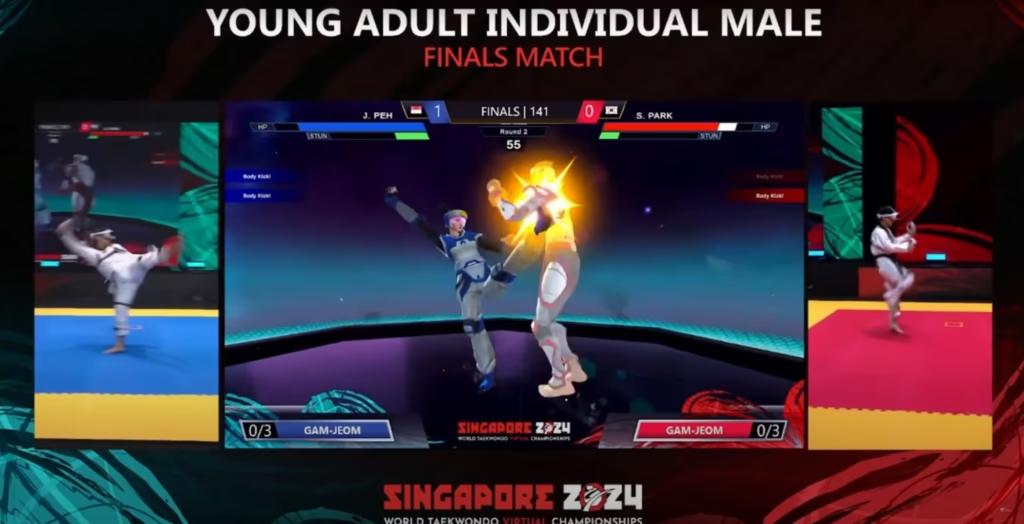
VTKD is a non-contact virtual sport game designed to simulate Taekwondo in a digital format. Players use a VR headset and AXIS motion tracking technology, allowing their physical movements to control their in-game avatars. The gameplay is similar to traditional fighting games like Street Fighter or Tekken, where rounds are won by knocking out the opponent or having a higher amount of health.
Key Features:
- Motion Tracking: AXIS nodes are placed on the spine, thighs, and shins to capture movements, particularly kicks, ensuring precise gameplay in a one-on-one format.
- Game Standard Format:
- Rounds last 60 seconds.
- Matches follow a best-of-three structure.
- The play area is a 4 x 4 meter space.
Health Bar
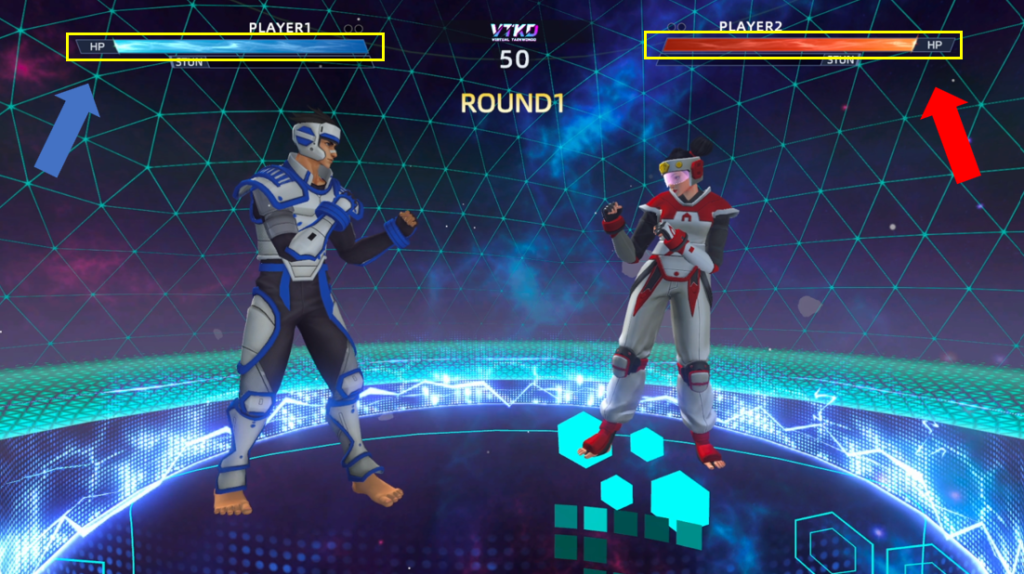
Each player has a Health Bar that matches their assigned color: the Blue player has a Blue Health Bar, and the Red player has a Red Health Bar.
On the Game Master’s screen, each player’s health is displayed above their respective character.
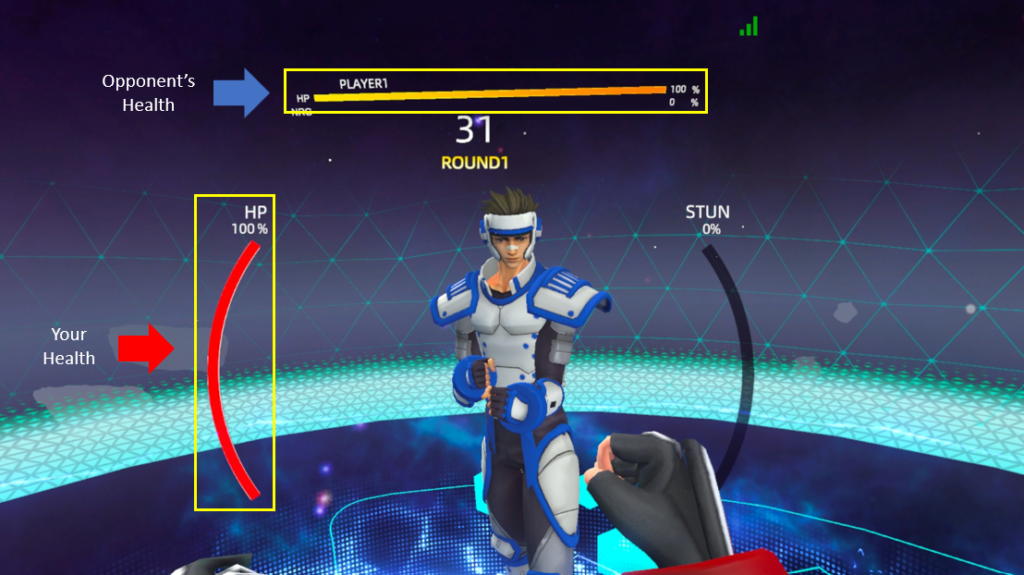
In the player’s VR view, the opponent’s health is shown above the opponent, while the player’s own health is displayed on the left side of the screen. The Health Bar decreases whenever the opponent successfully lands a strike on the body or head.
Strike
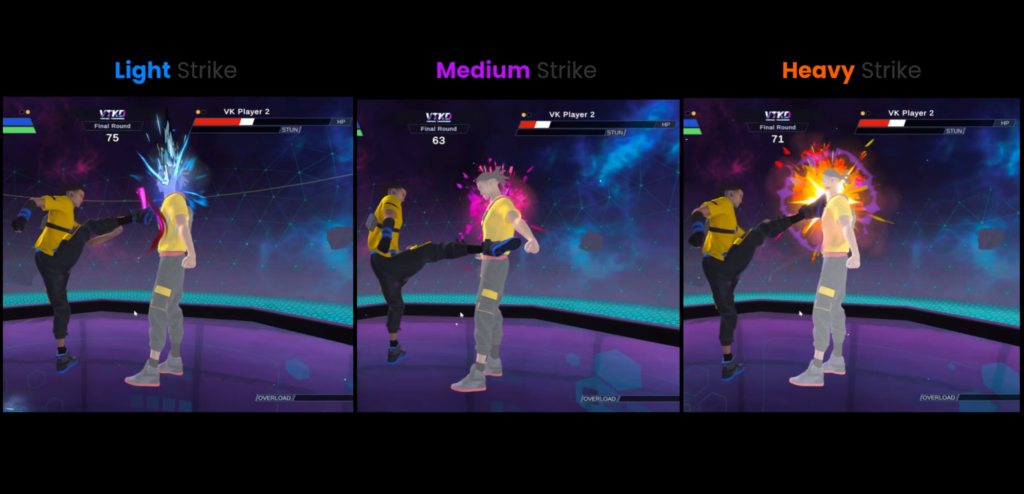
Attacking mechanics in VTKD.
Attacks can target the body (upper torso) and head. A successful hit to the body or head will damage the opponent.
There are three levels of damage—light, medium, and heavy. The damage type is determined by the acceleration of a successful strike. A strike must meet a minimum acceleration threshold; if not, no damage is dealt.
Head strikes deal double the damage of body strikes for each damage type. Only kicks cause damage; punches to the opponent’s body or head do not inflict any damage.
Block
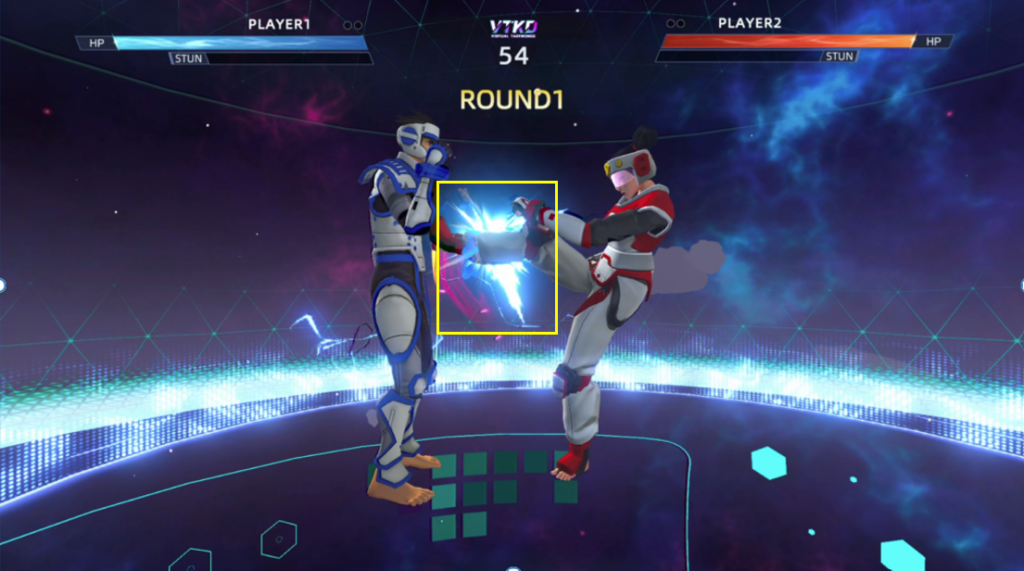
Defending mechanics in VTKD. Players can block an opponent’s attack by using their arms. When a block is successful, players receive both visual and audio feedback.
A successful block reduces the opponent’s stun meter if it is not already full.
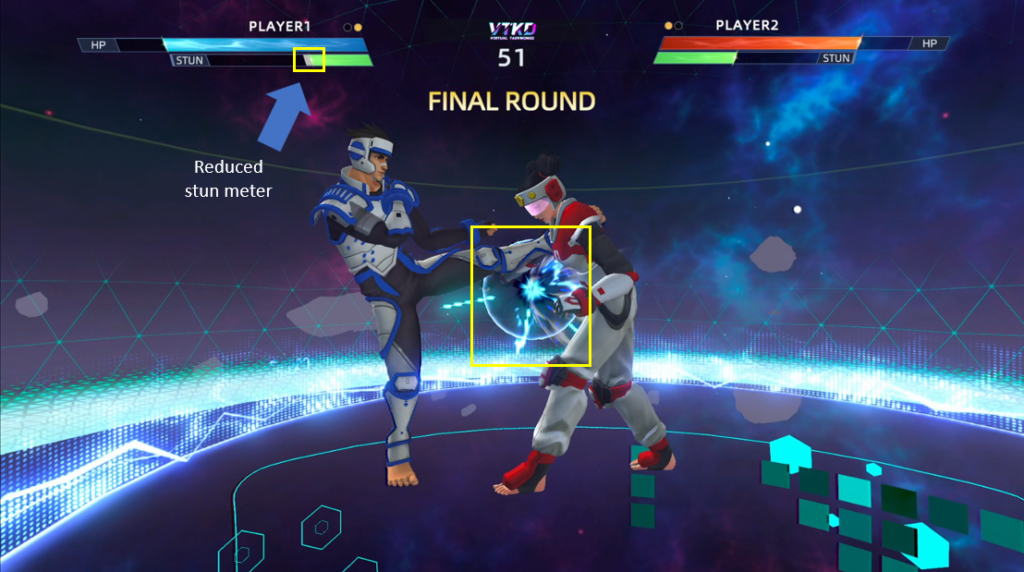
Stun
Immobilizing mechanics in VTKD.
A player can build up their stun power by successfully landing strikes (kicks or punches) on their opponent. Once the stun power is fully charged, the next successful kick will activate it.
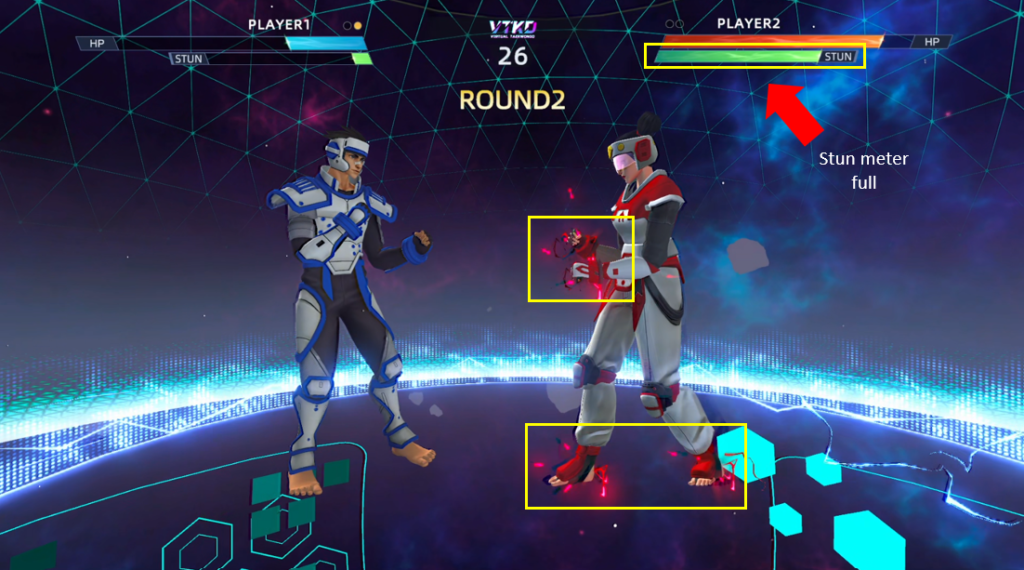
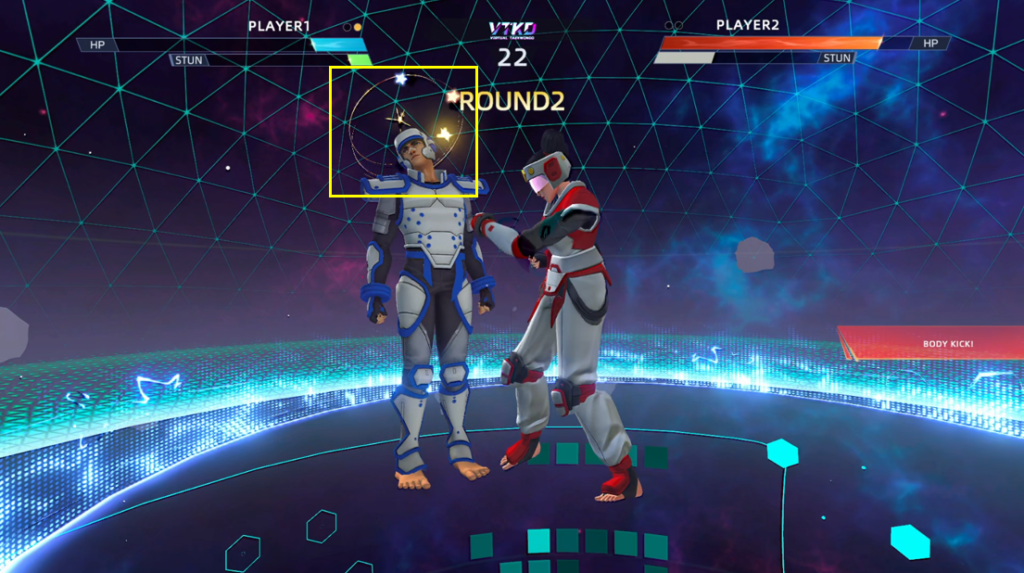
When stunned, the opponent is immobilized for 3 seconds and cannot defend themselves. During this time, the opposing player can deal damage freely to the stunned player. After 3 seconds, the stunned player regains control and can resume gameplay as normal. The opponent’s stun charge can be gradually reduced by successfully blocking their attacks.
Break (“Kalyeo”)
There are two different separation mechanics in VTKD.
a. Automatic Break
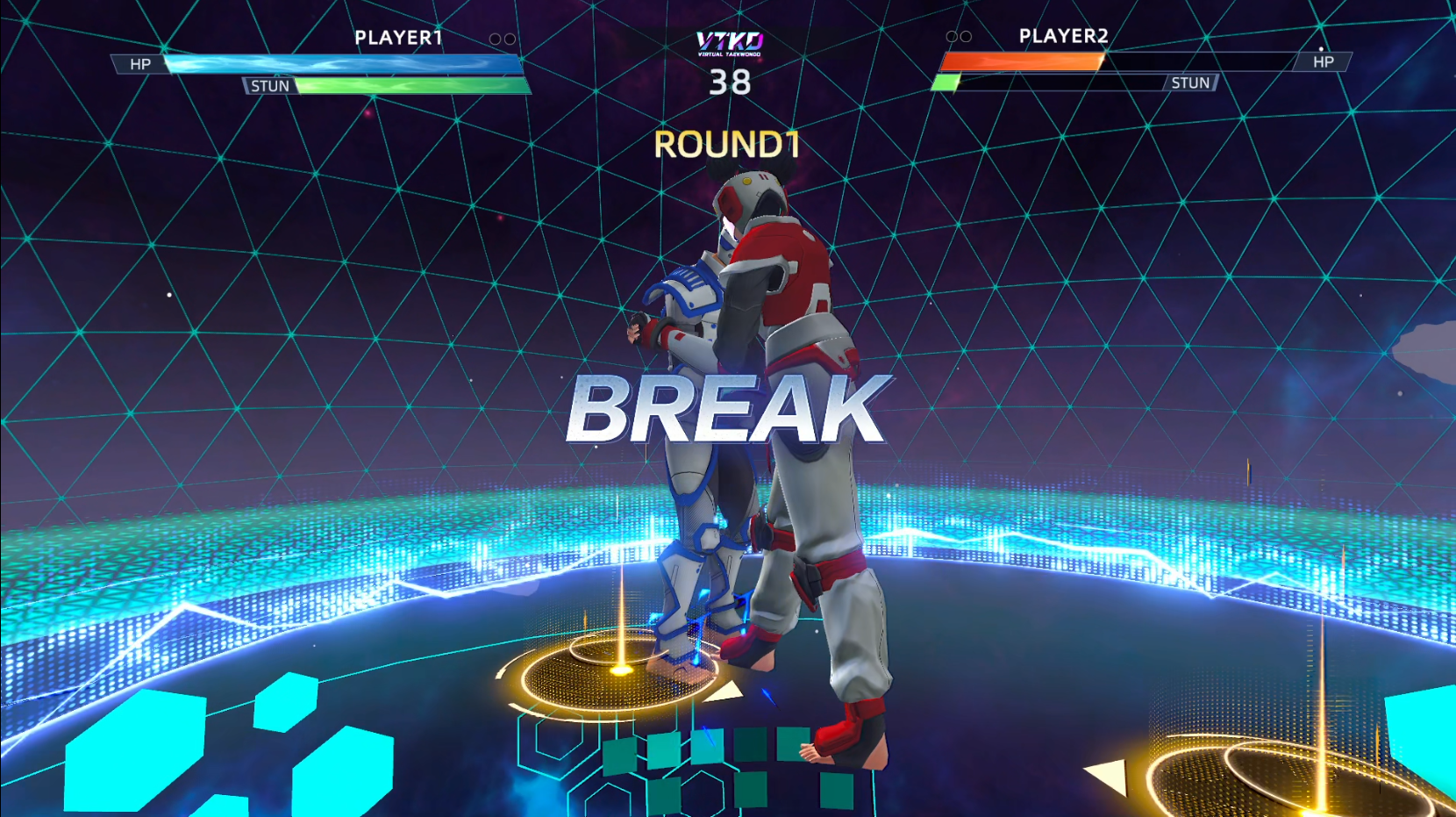
This break is triggered automatically pausing the game, when the players are:
- too close to each other
To resume, both players must return to their designated starting points, marked by a yellow circle visible only in their VR headset.
- equipment disconnected (AXIS nodes or dongle, PICO headset, PICO controllers).
To resume, Game Master must manually resume the game on the PC.
b. Referee Timeout
This break is manually triggered by Game Master; players are required to return to their starting points; the Game Master then manually resumes the game when ready.
Boundary Damage
A function that can be toggled in the settings, the boundary damage is an in-game feature where the boundary will start shrinking if neither player lands a hit nor block an attack after 3 seconds. It will continue to shrink until it reaches a minimum size and will only reset to its original size when one player makes contact with the other.
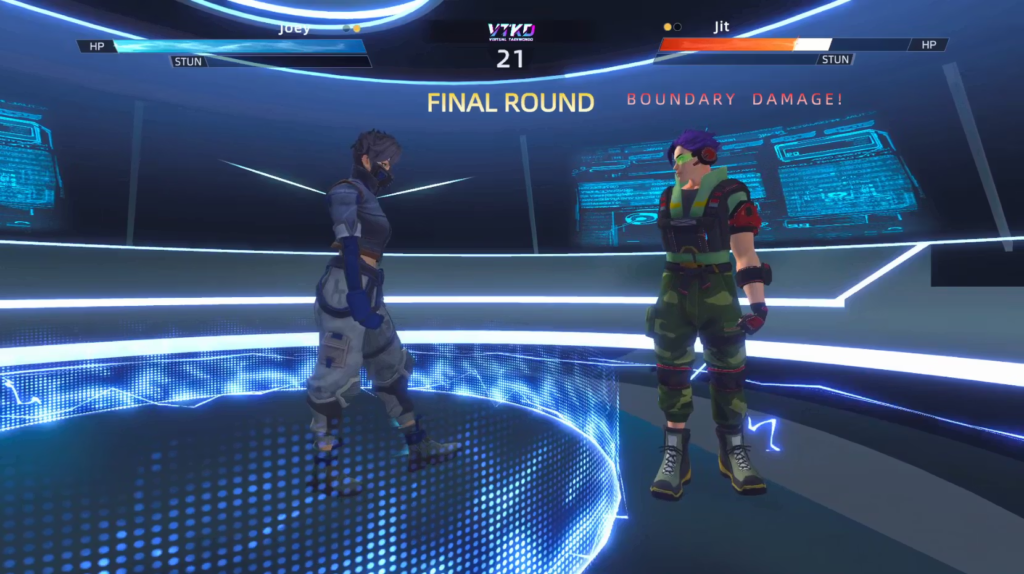
If a player steps outside the shrinking boundary, they are penalised with a health deduction. Health continues to be deducted each second the player is outside of the shrinking boundary, until the player either steps back within the boundary, or makes contact with the opponent which resets the boundary to its original size.
Results Screen
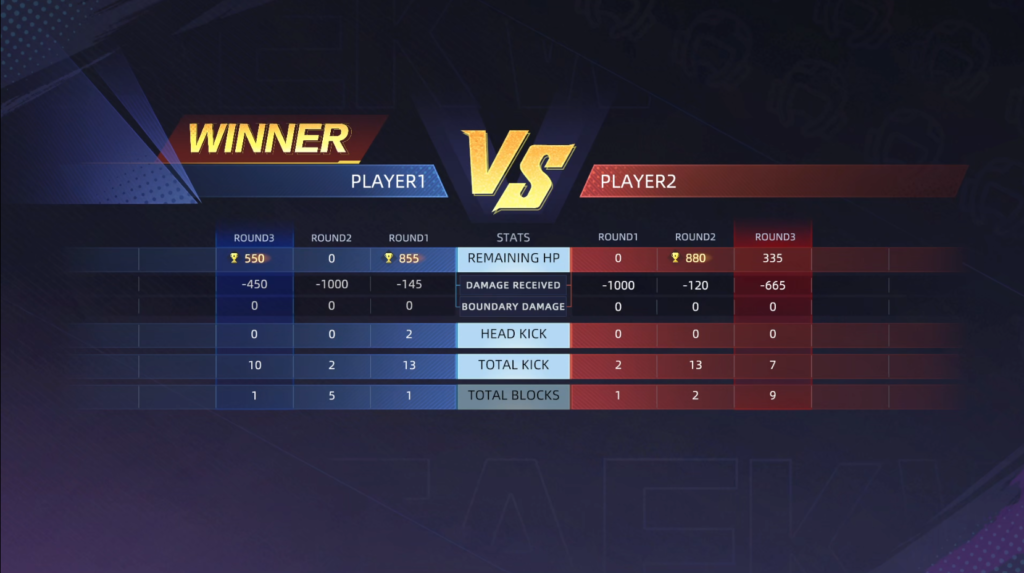
The results screen declares the winner of each round, which is primarily determined by the Health Bar.
Results Screen are shown in two stages: Intermission (after each round) and Final Result (after the final round).
A trophy will appear on the winning player’s remaining HP after each round. In the final round, a “Winner” text appears next to the winning player’s name.
A player can win a round by one of three methods:
- knocking out the opponent by reducing their HP to 0,
- retaining more HP than the opponent at the end of the round, or
- winning by specific draw criteria (explained later).
The results screen also displays game statistics important for tie-breaker situations.
- Total Damage is the damage dealt to the opponent,
- Head Kicks refers to successful kicks to the head;
- Total Kicks refers to number of successful kicks to the body and head combined;
- Total Blocks refers to number of successful blocks;
- Boundary Damage refers to damage received from stepping out of boundary.
Win Criteria When Match Ends in a Draw
When both players finish the round with the same HP, the following criteria are used to determine the winner and in order:
- The player with the most headshots wins the round.
- The player with the fewer number of kicks wins the round.
- The player who landed the last successful hit wins the round.
Some Examples:
Round 1: Both players have the same HP, a player wins due to fewer total kicks.
Round 2: Both players have the same HP, a player wins due to more headshots.